Profiles of Artistes, Composers, Musicologists
Unless otherwise specified, the profiles in this section are
from
The Garland, Another Garland, Yet Another Garland and The
Fragrant Garland by Mr.N.Rajagopalan
KANAKADASA
- COMPOSER...............(16th Century)
One of the
great Bhagavatha Maha Purushas Karnataka gave,Thimmappa , son of Birappa,
a poligar chief of Kuruba community came to be called 'Kanaka Nayaka' as
he found a treasure-trove of gold. He was initiated by Vyasaraya.
He lived at Tirupathi in his last days. He has composed:
Hari Bhakti
Sara
Nala Charitra
Mohana Tarangini
Nara Simhastava
Devotional
songs in Kannada like 'Krishna Nee Begane' (Yaman)
His devotional
songs and devoted work elevated the backward communities. His signatures
were 'Kagineli Kesava', 'Velapuri Kesava', etc.
KAVI KUNJARA
BHARATI - COMPOSER...............(1810-1896)
Kavi Kunjara
Bharati was born at Perungarai (Ramanathapuram). Father Subramanya
Bharathi and grandfather Kotiswara Bharathi were scholars in Tamil &
Sanskrit. The family legacy was enriched further by the grandson
of Kavi Kunjara Bharathi, viz., Kotiswara Ayyar, the illustrious author
of 72 melaraga kirtanas in Tamil. Kavi Kunjara began to write poetry
in his teens and soon became a friend of Madhura Kavi Bharathi. Gowri
Vallabha, the Rajah of Sivaganga was pleased to appoint him as Asthana
Vidwan in his court. The Rajah of Ramnad folowed suit. 'Skanda Purana
Kirtanas' (1865-1870) are his greatest contribution. 'Azhagar Kuravanji'
and 'Perinba Kirthanaigal' are his other compositions which are popular.
Some of his pieces are:
Elloraiyum
Polave - Suddhasaveri
Ennadi Penne
Unakku - Begada
Pithanavan
- Anandbairavi
Singaravelanai
- Danyasi
Sannidhi Kandu
- Mohanam
The title 'Kavi
Kunjaram' was conferred by the Rajah of Sivaganga. The first song
was the favourite of S.G.Kittappa and T.R.Mahalingam who have given disc
recordings of it.
Dr.U.Ve. Swaminatha
Ayyar mentions that Athmanatha Bhagavather (nephew) and Kunjaram (grandson)
were also scholars and that they propogated Bharathi's songs. Perungarai
village presented another composer of repute Madura Kavi Bharati (c.1780)
who is known for his devotional padas..
KARUR QUARTETTE
(GARBHAPURI) - COMPOSERS & MUSICIANS...............(1860-1967)
Karur is known
in Sanskrit as Garbhapuri and in musical circles, the Garbhapuri Quartette
have carved out for themselves a unique place. The Quartette comprised:
Pedda Devudu
Venkatasubbiah 1860-1887
Chinna Devudu
Krishniah 1861-1901
Karur Chinnaswamiah
1888-1967 &
Dakshinamurti
Sastri (not known)
The first
three were sons of Narasa Ayyar and Akhilandammal. Dakshinamurthi
Sastri was a cousin of the other three and was a lyricist and teacher in
the High School at Karur.
They had their
training under Nemam Subramania Ayyar, a direct disciple of Tyagaraja.
Karur Chinna Devudu composed several songs like 'Neramanchakura' (Sankarabharanam).
His violin duets with his elder brother, Pedda Devudu had a premature end
when the elder died. Chinna Devudu then trained his younger, Chinnaswamiah
and both were playing together.
It was Karur
Chinnaswamiah who was later honoured by the Music Academy wth the conferemnt
of the title 'Snagita Kalanidhi' in 1950. He had accompanied most
of the great artistes. His musical expertise was sound and used the
full bow Musiri Subramanya Ayyar, K.S.Papa Venkatramiah, G.N.Balasubramaniam
and Varahoor Muthuswami Ayyar were his disciples. His capacity to
present rich ragabhava, wide range of ragas, unequalled skill in producing
rare and unique tones on his instrument and his remarkable attractive style
have been complimented by Keerthanacharya C.R.Srinivasa Ayyangar.
Chinna Devudu
composed note-swaras also like Muthuswami Dikshitar. 'Sami Ninne' 9Sree
raga - adi tala) varna is his. Their compositions are all in the
tradition of Tyagaraja. Prof.P. Sambamurthi Ayyar says that Dakshinamurthi
Sastri wrote the Sahityas (script) which were set to music by Devudayya
and that the two are called Garbhapuri composers after their signature
'Garbhapuri'. A collection of the compositions has been published
by the Music Academy, Madras..
GHANAM
BOBBILI KESAVAYYA - VOCALIST...............(March 21, 1763 - d.not known)
Bobbili has
presented a number of musicians of repute of which Kesavayya was truly
famous and substantial. The others include Appiah Garu, Kanniah Garu,
Krishnamurti and Sambayya Garu (all 19th Century), Appiah Garu was a vocalist
too, who brought out jathi and gathi bedas.
Kesavayya,
born at Bobbili, had his training in music under his father Gopalayya.
His mother was Ranganayaki. He was well-versed in Sanskrit and Telugu
and had learnt 'pranayamam' from Narasimha Yogi. He was superb
in the 'Ghana' style of singing and was of a dominant nature. Proud
of his artistic attainments, he assumed the provoking title of 'Bhooloka
Chapa Chutti' (one who could roll the world into a mat). Due
to his disinclination to take presents from all, he came to be presented
with a large number of tamburs. In the course of his visits, he reached
the then cultural centre of Tanjore. It was his wish to establish
his pre-eminence and undisputed sway over all the musicians wherever he
wne. Over-awed by the grandeur of his retinue and the display of
tamburs and other paraphernalia coupled with the advance knowledge of real
prowess, artistes would bow down meekly and avoid confrontation and probable
shame. At Tanjore, he had held out this challenge for a contest.
That there was a contest was true. Dr.U.Ve.Swaminatha Ayyar mentions
that Pallavi Gopalayyar feigned to contest but yielded to the visiting
artiste. He has also mentioned that Tsallagallo Pallavi Doraiswami
Ayyar (1782-1816) of Tiruvaiyaru recorded success over Kesavayya and retrieved
even the presents got against Pallavi Gopalayyar. The piece chosen
for Pallavi in the contest was 'Chellunataraymodi' (Pantuvarali raga Triputa
tala). There is another version of Syama Sastri taking the contest.
Probably this had taken place prior to the meet with Doraiswami Ayyar.
The common
version in currency is that Rajah Serfoji turned to Syama Sastri of the
Carnatic Trinity to uphold the honour and the orestige of the Tanjore artistes
and the Court. Syama Sastri invoked the blessings of his patron deity
with the famous piece 'Devi Brova Samyamidhe' (Chintamani). With
his brilliant exposition in Sarabhanandana tala, Sastri established his
supremacy over Bobbili Kesavayya. The ruler sent Kesavayya with some
presents. An eminent vidwan, Kesavayya both gained and lost by his
audacious affront to other artistes. It looks that Tanjore proved
to be his waterloo.
At the request
of Rajah Serfoji, Kesavayya gave lessons to Ghanam Krishnayyar, who rose
to dizzy heights besides being a composer of renown. Kesavayya's
descendents like Vijaya Varadayya, Raghavayya and Varadayya were veena
artistes in the ghana style.
S.G. KITAPPA
- DRAMATIST...............(1906-1933)
His glittering
entrance on the stage was followed by the song 'Elloraiyum Polave Ennai,
Ennalagumodi Podi' (Can you take me just as you think of others?) in his
all-conquering, sweet, honeyed, divine and commanding voice soaking everyone
in the ocean of rejuvenating, romantic, lilting music. There was
no need for the heroine to answer the query in the song. The audience,
nay the musical world responded in chorus that none was ever guilty of
taking him on par with others. Without doubt, history had not recorded
any like him before and we have seen none since the brilliant life of the
genius ended - well three years before he attained the age of thirty.
Great lives end quickly. God takes those young whom He loves.
How true it is!
The voice of
gold whirled with ease and felicity in the upper octave even as the 'Homa'
bird circles with its proverbial nature and deliberate option. Ramakrishna
Paramahamsa has mentioned that this fabled species
'live so high
up in Heavens and love those high regions so dearly that they never come
down to earth. No sooner do these fledglings find out that they are
falling downwards than they immediately change their course and instintively
fly up....'
Ramakrishna
cites Sukhdeva, Narada, Jesus, Sankaracharya, etc. How true it is
that S.G.Kittappa, the dramatist and musician whom we are dealing with
here, literally spent his short sojourn on this planet at the lofty heights
of the upper octave and left for his celestial abode.
He was not
a mere legend. Fortunately recorded music has caught shades of the
brilliance of the musician and his musical miracle for the benefit of posterity.
Can anyone dream of matching
Evarani -
Devamrutavarshini or
Ganalola -
Suddha Seemantini or
Kodayile Elaipatrikollum
- Ragamalika
Harikesanallur
Muthiah Bhagavathar gave a recording of 'Evarani'. Later he heard
the recorded version of the song rendered by S.G.Kittappa. Promptly
he told the recording company not to release his own and refunded the honorarium.
Good Sahitya (lyric) is pleasant. When it is conveyed and clothed
with melody, it is rapturous. Richer the melody, sahitya is apt to
be noticed less and lesser till ecstacy rules. Kittappa could take
his listeners to the dizzier realms of ecstatic music. He had the
able assistance of his brother S.G.Kasi Ayyar, harmonist and K.B.Sundarambal,
another of those Hma birds with the sweetest of honeyed melody.
It is stated
that he would adopt the song of Vishnu Digambar 'Raghupathi Raghava Rajaram'
for the concluding chorus as a mark of respect to its author. Gandhiji's
heart was in that song. Kittappa would recount any that he heard
once. Eka santha grahi. He heard the Khamas raga piece 'Sapathi
kilasa' of Piyare Saheb and it that day at his drama. This visiting
musician was thrilled and presented a gold pendant. It is stated
that Kittappa once treated Naina Pillai, Azhaganambi Pillai and Dakshinamurti
Pillai with 'Evarani' etc with raga alapana on the stage at their request
and for their pleasure. As Maha Vaidyanatha Ayyar was there for concerts
and T.N.Rajarathinam for nagaswaram, S.G.Kittappa was for stage music,
which was one hundred percent Carnatic music full of virtue, purity and
class (swaroopa) .
KOTISWARA
AYYAR - COMPOSER...............(January 1870-October 21, 1936)
An eminent
composer in Tamil, Kotiswara Ayyar was a grandson of the great scholar
and composer, Kavi Kunjara Bharati (1810-1896), who authored the Skanda
Purana kirthanas, Azhagar Kuravanji and several kirtanas. Bharati
was a prolific composer and in Kotiswara Ayyar one sees a worthy and capable
successor in the family. His father, Naganatha Ayyar of Nandanur
near Elayangudi, the sacred place of Saint Maranar, was also a scholar
and composer. Music is the life-line of the family and the popular
singer of devotional songs, K.Veeramani is a grandson of Kotiswara Ayyar.
Kotiswara studied
at Manamadurai, Tiruchirapalli and Madras. Initially, he was in the
Criminal Intelligence Department and later transalator in the High Court,
Madras. On the musical side, he studied under the stalwarts, Poochi
(Ramnad) Srinivasa Ayyangar and Patnam Subramania Ayyar. There was
thus a parallel line of activity throughout - as NMN writes - 'one for
livelihood and the other for life's ruling passion'.
Kotiswara Ayyar
has composed about two hundred pieces. His seventy-two melakarta
kirtanas are a great contribution carving out for him a place among great
composers. Has composed varnams in Tamil in the ragas Saveri, Danyasi,
Bilahari, etc. His signature is 'Kavi Kunjara Dasan', probably as
a tribute to his maternal grandfather. His compositions are philosophical
and his 'Kanda Gnanamudham' is a valuable work. He has published
the works of Kavi Kunjara Bharati also. For his mastery in Todi raga,
he was called 'Todi Koti'. He has sung in praise of Sri Tyagaraja
in his 'Ininamakkoru kavalaiyumillai' - meaning henceforth we have no need
for any worry.'
A saintly
soul and a great composer, his compositions are in popular use like 'Velava
Va' (Kiravani).
BRAHMASRI
PARUTHIYUR KRISHNA SASTRI - Pioneer Of Religious Discourses...............(1845
– 1911)
Paruthiyur
Krishna was born in the calm and tiny village Paruthiyur on the northern
banks of Kudamuruti River, near Sengalipuram, in Thiruvarur District of
Tamil Nadu, to Lakshmi and Ramasesha Sastri. Paruthiyur Krishna Sastri
grew up to become the greatest exponent of the Ramayana. He was a versatile
Sanskrit scholar well versed in Vedas and Sastras, Puranas and Ithihasas
and all the scriptures. He was a great poet, a writer, composer, singer,
astrologer, philosopher, a famous Harikathakalakshepa and Pravachan exponent.
He was an avid connoisseur of Hinduism and a Philanthropist known for his
Dhaana and Dharma and above all he was the greatest Bhakta with immense
devotion to Sri Rama.
He was educated
in the Sastras and specialized in Vedanta, Vyakarana, Mimamsa, Tarka Sastra,
Carnatic music and Naam Sangeerthan under the training of Vaidyanatha Dikshitar
Sengalipuram Muthannaval (1830-1893) and Mahamahopathyaya Thyagaraja Mahi
Raja Mannargudi Raju Sastri (1815-1903). Krishna Sastri had got his "Ramanama
Mantropadesam" from Marudhanallur Kodandarama Swamigal and since then everything
was Rama for Krishna Sastri and all what he did all his life was Ram Nama
Japam.
Sastri became
an authority on Valmikis's Ramayana to the extent that he came to be called
by people of his town as "Ramayana Sastrigal". Brahmasri Paruthiyur Krishna
Sastri did Pravachans for over forty years of his life. Sastri's Pravachans
induced Bhakti, he never missed a chance to talk about the virtues of Sri
Rama. He used the Ramayana to illustrate several important ideas and concepts
from other scriptures, thus providing a clear link between all our major
scriptural works. Sastri was a pioneer who made Hindu Religious Discourses
an art and a respectable profession. Reading the original sloka and presenting
the meaning was the methodology followed by Pundits before. Paruthiyur
Krishna Sastri was the first exponent who gave various interpretations
and commentary to each verse and created a new style. Renovating and maintaining
temples, building a temple for Sri Rama, doing Dhana -Dharma and helping
the poor, saying and singing the story of Rama, propagating Sri Rama's
virtues, inducing bhakti and good character in the community was the goal
of Sastri's Life.
Kowmudhisomam,
Rasanishyandini, Nandhi Mangala Slokas, Kavivilasa Manidharpanam, Lakshminarayana
Dhvisahasri, Sita Kalyanam, Ganga Sadhagam, Mahalakshmi Sadhagam, Meenakshi
Sadhagam, Vishalakshi Sadhagam, Yeka Chakrapurram, Krishna Sastri
Ramayanam, Krishna Sastriyin Balakandam, Ramayana Slokas are some of his
works. He had composed hundreds of songs in Tamil and Sanskrit on Rama,
Mahalakshmi, Anjaneya, Narayana and Shiva. Many of his works and palm leaf
manuscripts have never been found. He had written 100 slokas each on each
of the Characters of the Ramayana. This
bhakta attained mukti through Kapala Moksha in 1911.
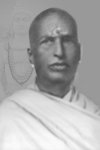
(Information & photo provided by C.R. Kaushik,Texas, USA)
RASANISHYANDHINI: Sanskrit Slokas with Tamil meanings, Samvada Ramayana Vyakyana
by Paruthiyur Krishna Sastri, Rajkumar Bharathi
TITTE KRISHNA
AYYANGAR - VOCALIST...............(b.November 24, 1902)
Grandson of
Titte Rangachariar, a disciple of Tillaisthanam Rama Ayyangar and son of
Titte Narayana Ayyangar, Krishna Ayyangar had his initial training under
his father, who was Asthana Vidwan, Mysore Court. Like his father,
he had special training under Bidaram Krishnappa and Veena Seshanna.
Krishna Ayyangar gave his maiden performance qute appropriately at the
Tyagaraja Aradhana Festival, Tiruvaiyaru at the age of fourteen with Papa
Venkatrama Ayyar on violin and Tanjore Vaidyanatha Ayyar on mridangam.
He had a sweet voice and superb tanam rendering. A votary of traditional
style and values, he has given a large number of concerts at sabhas, All
India Radio and elsewhere.
Krishna Ayyangar
was the Founder
of Sri Tyagaraja Sangeetha Vidwath Sabha, Mylapore (1966);
was Chairman,
Board of Studies in Music, University of Mysore and
was Member,
Experts Committee, Music Academy, Madras.
He has authored
a book on the Theory and Practice of Carnatic Music, called 'Karnataka
Sangeetha Lakshya Lakshana Paddhati' (1973) and another 'Rare Compositions
of Veena Subbanna.'
In recognition
of his good services to Carnatic Music and classical rendering, he has
been honoured with titles & honours:
Gana Visharada
by the Maharaja of Mysore - 1946
Award from
the Sangita Natak Academy, Bangalore - 1965
Ganakala Sindhu
by the Eighth Sangeeth Sammelan - 1966
Award from
the Rajyothsava Committee - 1972
Sangita Kalaratna
by the Gayaka Samajam, Bangalore - 1982
GHANAM
KRISHNA AYYAR - VOCALIST AND COMPOSER...............(1790-1854)
Rajsri Gautam
points out that padams in Telugu or Tamil were all written on Tamil soil.
Muthu Thandavar, Sarangapani, Muvvanallur Sabhapati Ayyar and Ghanam Krishna
Ayyar all belong to the great line of padam composers.
The term 'pada'
has been used even in 'Sangita Ratnakara' of Sarangadeva and was
used to denote any musical composition. 'Sringara Sankirtanalu' came
into vogue since the days of Tallapakkam composers in the 15th century.
Kshetragna, in the seventeenth century, appeared as the 'Father of Sringal
Padams' and perfected the style. The padam emerged as a distinct
genre with a nayaka-nayaki motif, three or more charanams, to be sung in
the particular ragas which are conducive to enhance the 'bhava' of the
padams. Krishna Ayyar is called the 'Tamil Kshetragna' for the excellence
of his padams. Kirtanacharya C.R.Srinivasa Ayyangar writes: 'Ghanam
Krishna Ayyar stands as a master of Tamil. It is regarded as the
high watermark of musical
proficiency to sing his padams in the way they have been built.'
Krishna Ayyar
is among the most illustrious composers. Dr.U.Ve. Swaminatha
Ayyar has listed seventy-three kirtans, padams, sindhu and kalithurai of
which fifty-seven were published by him. Some of the compositions
are:
Velavare -
Bairavi
Parengum Parthalum
- Kalyani
Teruvil Varano
- Kambhoji
Yaar Poye
- Todi
Niddirayil
soppanathil - Pantuvarali
Ella Arumaigalum
- Todi
Tiruvottiyur
Tyagarajan - Atana
Krishna Ayyar
was grand not only in his compositions but was so in his music too.
He specialised in Ghanam rendition. His father, Ramaswami Ayyar was
musician, composer and Asthana Vidwan of the Tanjore Court. His four
brothers were all musicians. After initial training under his father,
Krishna Ayyar with his brothers, Subbarama Ayyar and Sundaram Ayyar had
training under Ariyalur Shenbagamannar and then Pachimiriam Adippayya in
the distinguished company of Syama Sastri and Pallavi Gopala Ayyar.
All the three brothers became samasthana vidwans. The family was
a shrine for music.
Krishna Ayyar,
at the instance of the ruler, learnt from Bobbili Kesavayya the intricacies
of 'ghanam' singing and became proficient in it. He found his
patrons in Kabistalam Ramachandra Moopanar, Tiruvidaimarudur Amar Singh
and Kacchi Kalyanaranga of Udaiyarpalayam. He was close to Choukam
Seenu Ayyangar and Sankarabharanam Narasayya. He had met Tyagaraja
at Tiruvaiyaru and Paidala Gurumurti Sastri at Madras. The song 'Summa
Summa Varuguma Sugam' (Atana) was composed and sung before Tyagaraja.
He sang at the reception to the Governor, Sir Thomas Munro at Madras.
He had composed songs in praise of several deities in Thanjavur and Tiruchirapalli
districts. His devotion to Kacchi Kalyanaranga was too profound
for description. He had the obsession that Kacchi's appreciationwas
worth several kingdoms. He would have flowered into one of the all-time
greats with his erudition, musical acumen but he chose to stick on to that
local chieftan of the arid area. he himself posed this to his patron
when there was a shade of a lack of cordiality. Krishna Ayyar told
him in a song that he stuck to him sacrificing his, all out of love.
The patron surrendered since the musician's sacrifice was too enormous
and magnanimous to be compensated. Ayyar foreswore a life of meteoric
rice and princely luxury and cchose the life of commonplace, by deliberate
intent out of sheer regard for a poor patron.
Krishna Ayyar's
dedication to art was phenomenal. When Kesavayya started his tuitions,
he would retire to Kabistalam, practise intensely with a will to succeed
and come back fully accomplished and satisy Bobbili and the ruler.
He was catapulted to fame, popularity and status. He had a magnificient
personality and travelled on horse back. When he became old, Kacchiranga
presented him with a palanquin and men. He commanded considerable
respect and his word was carried out earnestly especially in the renovation
of temples, tanks, etc. His signature is 'Velar'. His disciples
included:
Tanjore Adimurthi
Ayyar
Gopala Krishna
Bharati
Venkatasubba
Ayyar ( father of U.Ve.Sa)
Krishna Bhagavathar,
Subbaraya Ayyar and
Nagaswaram
Subramaniam.
TIRUKODIKAVAL
KRISHNA AYYAR - VIOLIN MAESTRO : A LEGEND ...............(1857-1913)
Tirukodikaval
is one of the villages endowed by Nature with exquisite beauty and environment
to promote culture and music. There must have been a great past for
musical affluence since the temple in the village depicts the scene of
a victorius army being received by a band of musicians, dancers and kolattam
artistes. Kuppuswami Ayyar was a scholar in five languages and was
giving musical discourses. Krishna Ayyar was his son born at Marathurai
near Pandanallur. He had his training in music under his father and
later with Kothavasal Venkatrama Ayyar, a renowned composer of tana varnmas.
As he did not have a voice conducive to play the role of a vocalist, he
switched over to violin for good with training under Sathanur Panchanadha
Ayyar and Fiddle Subbarayar. He benefited much by hearing regularly
Tiruvalangadu Tyagaraja Sastri.
Krishna Ayyar
is among the few immortals among violinists. His play was masterly
with masculine grandeur and a touch of genius. A prodigy, he could
play Ata tala varna on a single string. Actually he did carry on
at a concert in 1908 at Gokhale Hall, Madras for about two hours when the
panchama string gave way. He could play in four octaves - slow or
fast and the swara exercise on a single string . Only top artistes
like Maha Vaidyanatha Ayyar, Patnam Subramania Ayyar or Sarabha Sastri
could gainfully take him as an accompanist. Lesser celbrities were
nervous of his presence as he might dwarf them at concerts. He was
at his superb best in his solos as they gave liberty, scope and time for
skill, creativity, imaginative play and phrasing. Generally, when
he accompanied a vidwan at a concert, a solo on the next day too was arranged.
Krishna Ayyar
was very famous for his strenuous daily practice. He would repeat
varnams like:
Vanajakshi
- Kalyani -Ata
Viriboni -
Bairavi - Ata
Sarasuda -
Saveri - Adi
Intachalamu
- Begada - Adi
Regular practice,
dedication to the furtherance of his command over his play, skill and proficiency
are proverbial. His eternal search for greater excellence was reflected
in his consistent practice of swaras in different tempos and octaves.
He used to play the swara exercises on a single string. he practised
playing in a single stroke of the bow 4, 8, 16,32 and 64 notes. he
developed a high speed. He ushered in a technique called 'izhaittu
vasippu and produced ascending and descending glides with remarkable effect.
Quest for knowledge
and excellence knows no barrier or discomfort. Play at a concert
is done under constraint and mental editing and censorship keeping in view
time, place, mood and level of the audience. Real brilliance, unbridled
creativity and originality could not easily be brought out since an isolated
wrong note might get wide currency and magnified importance. It is
the practice that gives the fullest scope for manodharma, the creative
urge and experiments. Krishna Ayyar's early morn exercises were famous.
Poochi Srinivasa Ayyangar, a celebrated vocalist, in his anxiety to hear
this, without Krishna Ayyar suffering from any inhibition due to his presence,
went stealthily, slept at night on the outer pial of the house where Krishna
Ayyar stayed at Triplicane during a visit for a concert and heard Ayyar's
bold and adventurous art with bow and fingering and the resultant melody
stealthily. He was in a trance enjoying the uninhibited creative
flights in unexplored regions till Krishna Ayyar came out and found, to
his surprise, Ayyangar sitting on the pial. A creative artist has
an unsatiable appetite and looks for knowledge, suggestions etc., wherever
it comes from as indicated in a Rig Vedic hymn.
Krishna Ayyar
was in the midst of a solo in 1904 in Triplicane when news about the demise
of Sarabha Sastri came. The forty-seven year old maestro wept, and
wept as only a sincere heart could, and said:
'When Maha
Vaidyanatha Ayyar passed away, I lost my right hand,
With Sarabha's
departure, I have lost my left hand also.
What am I
going to play for hearafter?'
The last pathos-leaden
question brings out the ultimate goal, the cry of a classical reminiscing
his joy in sharing the concert stage with those two celebrities which was
no longer to be had. The true artist looks up for inspiration.
Krishna Ayyar saw vaccum in the world of music shorn of the melodies of
their voice and flute.
Krishna Ayyar's
disciples included:
Semmangudi
Narayanaswami Ayyar, his nephew and Tirukodikaval Ramaswami Ayyar.