MUSIC
Saint Thyagaraja
'FRAGRANT GOLD OF CARNATIC MUSIC' (1767 - 1847)
from A Garland by Shri.N. Rajagopalan
"The age of Chaturdandi, of Gita,
Prabandha, Thaya and Alapa had to give place to the age of Pada,
Kirtana and Krithi. In achieving this, Tyagaraja stands foremost with
his marvelous contribution... In sheer volume of output, he essays in the
direction of Purandara Dasa and Kshetragna; In devotion, religious fervour,
reformatory zeal and spiritual realisation, his songs approach those of
Purandara Dasa; when we think of him singing to his Rama in anguish, we
find in him a second Ramadas of Badrachala; in his lyrical moods he takes
a page off Kshetragna; in his Pancharatnas and some of his heavier compositions,
he treads the path of the earlier prabandha-karas and later varna-karas;
in turning out pieces now and then in the language of the Gods, he seems
to beckon his contemporary Dikshitar; when he sings of Mother Tripurasundari,
it appears as if Syama Sastri of Tanjore was sojourning at Tiruvotriyur;
and he could sustain himself through the task of a dramatic composition
like Narayana Tirtha or Merattur Venkatarama Bhagavathar and pay his homage
to a sampradaya sanctified by Jayadeva", observes
Dr.V.Raghavan in a superb succinct sum-up of the life of the saint-composer
Tyagaraja.
The most popular of the Trinity,
Tyagaraja is one of the great immortals of the world. His compositions
are prodigious, the range of ragas vast and staggering and the mode of
appeal to his Lord Rama absorbing, poignant and soul-stirring from the
most intimate and endearing to the most philosophical. The diction is superlative
yet simple; the delivery and flow are easy yet captivating. His personal
life symbolises fervent piety, absolute devotion, total surrender and gentle
affability. His heart is with the Lord and his mind overflows with bhakthi.
His compositions are outpourings of love, prayer and appeal. His life is
an epitome of the excellence of nobility and virtue. As Suddhananda Bharathi
said, 'Tyagaraja is the temple of Ram Nam - Ram Kokilam
- who warbles the glory of Rama from honey-dropping arbor of music. He
is a Mira in motion, a Kabir in devotion, a Purandara Dasa in music and
a Nammalwar in vision."
His large compositions and rich ragabhava
are so pronounced that Carnatic music is a second name for Tyagaraja. It
is difficult to visualise a full-scale concert without resort to his songs.
Dr.V. Raghavan said that 'If gold could be found with fragrance, it is
Tyagaraja, Kshetragna, Purandara Dasa or Jayadeva.'
Life:
Tyagaraja was the grandson of Giriraja
Kavi, a sanskrit poet in the Tanjore Court and son of Rama Brahman also
attached to the Court.
His mother was Santamma or Sitamma.
When he sang his 'Sitamma mayamma - Sri Ramuduma tandri' (Lalitha), one
could appreciate the dual relevance of the piece.
Rama Brahman was a vocalist and veena player. Giriraja came from Kakarla
village, Cumbum taluk in
Kurnool district (AP). Tyagaraja
was born on May 4, 1767 according to one tradition (Sarvahit, Chitra, 27th
Monday), and in 1759 according to another at Tiruvarur.
Subbarama Dikshitar gives the age
of Tyagaraja as 77 while Panju Bhagavathar mentions it as 88. Fortunately
Venkata Suri, his disciple's disciple had noted the
dates of birth of Tyagaraja and of his own guru on a cadjan leaf and it
is accepted by scholars. Further Syama Sastri, senior to the composer in
age, was born in 1762. Hence 1767 would be correct. Of the other two of
the Trinity of Carnatic music, Syama Sastri was five years
older and Muthuswami Dikshitar was to follow. '1750-1850 AD was the high
noon of the glory of Carnatic music.' Tyagaraja had the good fortune of
getting trained in music under Sonti Venkataramanayya. Tyagaraja refers
to himself in his 'Atukaradani' (Manoranjani) as one learned in vedas,
sastras, upanishads, etc. He was good in Telugu and Sanskrit. His compositions
are mainly in Telugu, some in Sanskrit and a few bilingual. Sage Narada
appeared as a sanyasin, presented him with the work 'Swararnava' and initiated
him into the intricacies of higher music.
In praise of Narada, he has composed...
Narada Guruswamy -Durbar raga
Sri Narada Nada Saraseeruha - Kanada
raga
Narada Gana Lola - Atana raga
Soon after his training Tyagaraja
rendered his song, 'Dorakuna Iduvanti Seva' (Bilahari) before a congregation
of musicians and poets. In the house of Sonti Venkatasubbiah at Tanjavur
and in the presence of samasthanam artistes, he made an elaborate raga
alapana in Kambhoji and sang his 'Mari mari ninne' (Adi tala) throwing
the audience into ecstasies - a delightful dip in the ocean of ganarasa.
Thus young Tyagaraja revealed his innate ability as composer and musician
even while very young. It is said that he studied kavya, alankara and nataka
under Govinda Dikshitar for four years and that Ramayana attracted him
most even then confirming the message of his advent in this world.
"His father was Rama Brahman;
his book was the immortal epic of Valmiki, Ramayana; his mantra was Rama;
his God was Rama and his life was a stream of Rama
Consciousness." - Suddhananda Bharati
During his travel to Tirupati (1839)
Madras, Kanchipuram, etc., he met the noble Upanishad Brahman at Kanchipuram.
It is relevant to note that Muthuswami Dikshitar too met that great Sanyasi.
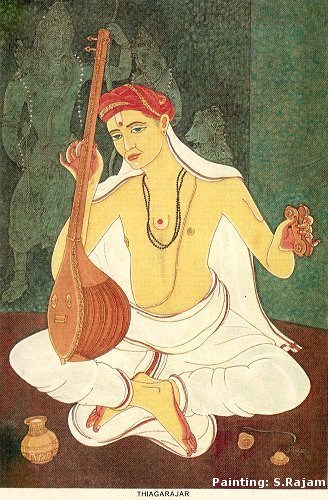
Tyagaraja was 'tall, brown, chest
broad, eyes sparkling, voice sweet, tulsi garland in neck, dressed like
a vedic scholar, sandal mark on his forehead, tambur (drone) in hand and
lived by unchavritti - rice collection'. He married Parvati first and on
he death, her sister, Kanakamba or Kamalamba. Later his only daughter,
Sitalakshmi had a son called Tyagaraja who died at the premature age of
thirty issueless.
His Philosophy:
The composer completed chanting
of Ramanama 96 crore times in his thirty-eighth year and had a full vision
of Sri Rama in Coronation.
His piety, poetical eminence and
musical greatness attracted the notice of the ruler of Tanjavur, who invited
Tyagaraja to his court but the poet declined and sang, 'Nidhi Chala Sukhama'
(Kalyani) meaning :
"Oh my mind, Tell me truly, which
conduces greatly to happiness - wealth or the sight of the Lord?
Which gives more happiness - flattery
of mere men bound up in their own conceit or the singing of the Lord who
has been praised by the wise Tyagaraja? (Translation by C.Ramanujachari)
He set his face against 'narastuti',
praise of men for profit or benefit - a philosophy and principle underlying
Hindu thought not to debase learning and knowledge. In fact this principle
was responsible for the old system of 'gurukulavasa' - of disciples learning
at the feet of the master and the master imparting knowledge but not for
money. In fact there is an incident or two where the disciples came to
grief for insisting on the payment of tuition fees (guru dakshina).
Dr. S.Radhakrishnan, former President
of India writes: "The name Tyagaraja means the prince of renouncers,
of those who give up worldly desires. In the case of Tyagaraja, renunciation
is the result of undistorted devotion to God...was a person of great humility,
utter self-effacement. He expressed the truths of the Upanishads and Bhagavat
Gita in simple and appealing language...He had deliberately chosen a life
of simple living by unchavritti taking what is voluntarily given."
In the context of his pre-eminence
in the fields of devotion, composition and singing and in personal life,
he would have been flooded with honours, receptions,
grants and gifts. But the Bard of Tiruvaiyaru would have none of them and
he chose to live in the 'Empire of Rama Consciousness' - Rama Bhakthi Samraiyamu'
(Suddha Bangala). And he chose to accept but one gift unexpectedly brought
by his own disciple, Wallajah Venkataramana, viz., a picture of Rama, which
with the rosary exists still.
Disciples:
N.M.N. (The Hindu) writes,
'To listen to a song of a composer
sung by the composer himself is a great privilege. In fact, it is a benediction,
a Kirtana Pratikshyam, seeing the song itself. Tyagaraja was creating songs
constantly. He was singing them all the time. His disciples were many and
lucky too. It was their enormous fortune to enjoy this experience of Kirtana
Pratikshyam all the time. It should have been a divine experience. They
should have really traveled with him. The world owes much to Tyagaraja's
disciples for their excellent work.'
Tyagaraja had a soft heart towards
his disciples. He visited the house of Vina Kuppa Ayyar at distant Tiruvotriyur
and, at his request, the house of the latter's patron, Kovur Sundara Mudaliar
in Bundar Street, where he sang 'Devagandhari' raga for six days to satisfy
his disciple.
One of the main reasons for the swift
and widespread awareness and adoption of his songs during his own time
was that he had a cluster of eminent disciples like
Sundara Bhagavathar and Krishna Bhagavatar of Umayalpuram, the nest of
musicians, Rama Ayyangar of Tillaistanam, Venkataramana Bhagavathar of
Wallajahpet and others. The compositions were taken to the far-flung corners
of South India by them. For instance, disciple Kannayya Bhagavathar went
to Trivandrum and Swati Tirunal Maharajah was so much impressed with the
eminence of Tyagaraja that he sent his own compositions through the great
musician, Shatkala Govinda Marar. On reading them Tyagaraja was delighted
with the all-round scholarship of the royal composer and he wrote a letter
to him. This letter signed by him was reported to be available at the Royal
Archives, Trivandrum. (Srimat Tyagaraja Vijaya Kavya by L.Muthiah Bhagavathar
- 1941).
The second reason is that the Saint
happened to be at Tiruvaiyaru close to the seat of royal power at Tanjore.
Visitors from far and near came to see, hear and pay their respects to
him like Toomu Narasimha Dasa (Guntur), Gopinath Battacharya (Benares)
and Govinda Marar (Trivandrum). A third reason is his regular bhajans which
were attended by devotees, admirers and scholars. It was during one of
such bhajans in 1843, at the interval between the purva and the uttara
bhagas, Govinda marar sang. The song 'Endaro Mahanubbavalu' (Sri raga)
was sung in praise of him and the galaxy of all great men - an obeisance
- by the disciples under instructions of the Saint.
These apart, his songs were true
gold with fragrance as stated by Dr.V.Raghavan. At the helm of all these,
Tyagaraja was a master of perfection and would allow no error or interpolation
to creep in. So, he called, on his return from Kancheepuram, all his disciples
and checked up the songs by actually hearing them daily. In effect, it
was a refresher course and a valedictory function combined. That was the
pinnacle of the Saint's acts to ensure that the Holy River Cauvery does
carry eternally nothing but the most rejuvenating and unpolluted sacred
waters in the shape of his chaste, authenticated renderings.
After Purandara Dasa, it is Tyagaraja
who cared most for 'methods' to ensure purity and propagation. 'He excluded
zealously pupils with the tendency to improvise variations, etc., to guard
the purity of his authentic creations.' - (A.M.C.Mudaliar). Imprimatur
was important to him. To borrow modern phraseology, Tyagaraja had the best
of a secretariat, public contact and publicity wing which was devoted,
loyal, effective and efficient.
Compositions:
Tyagaraja's compositions are remarkable
not only for their immense volume but also for variety and quality. 'The
highest musical excellence is found in his compositions
which we have come to call kritis, in which he captured and effectively
picturised the essence of ragas... there is a wide variety of form and
type from metrical compositions and settings to creations like 'Koluvaiyunnade'
(Devagandari) where sangatis are heaped and the sahityas are moulded like
Pallavis" (Dr.V.Raghavan). 'In addition to individual pieces, he composed
'Uthsava Sampradaya Kirtanas' and 'Divyanama Sankirtanas' for adoption
in bhajans and festivals.
In the line of Jayadeva (Gita Govinda),
Narayana Tirtha (Krishna Lila tarangini) and Merattur Venkatarama Bhagavathar
(Prahalada Charitra), Tyagaraja brought out
his musical plays 'Prahalada Bhakthi Vijaya' and 'Nauka Charitra'. The
songs of Nauka Charitram (one act) are of simple melody. A flowing cadence
and simple rhythm are their distinguishing features. 'Prahalada Bhakthi
Vijayam' is of five Acts with 45 kritis in 28 ragas and 132 verses. Tyagaraja
gives biographical notes in several songs. In his 'Varanarada', he says
he is a "Bavuka" meaning that he is a musician who thrills one's heart
and steals it ! Can anyone blame him as egoistic?
It is as a 'bavuka' he created Nauka
Charitram which has no authority behind it even as Gopala Krishna Bharati
wrote the opera 'Nandanar Charitram'. While less
than a thousand pieces are available, tradition has it that he composed
24,000 songs on the glory of Rama. He has availed of 250 ragas and he was
the first to use over sixty ragas for kirtanas.
The Glory:
"Every Kirtana is a beautiful
temple in which the great composer has installed the God of his heart for
worship by those who sing and those who hear."
- Rajaji.
"It may sound surprising that
even familiar ragas like karaharapriya, Harikamboji and Devagandhari are
his gifts. His magic touch could transform any scale into a raga."
- T.V.Subba Rao.
The glory, spiritual eminence, creativity,
imagination, emotional appeal to diverse sections of the public, enthralling
treatment of emotions as well as the wide coverage
of ragas, techniques, artifices and subtleties have been summed up in his
own song 'Ragaratna malikache' (Ritigaula) (which is composed in third
person) translated by Dr.V.Raghavan with conceptual fidelity as under:
"Come one and all and sing the hundreds
of gem-like melodies which Tyagaraja composed for the salvation of humanity;
songs which contain the essence of Vedas, the six Sastras, Puranas and
Agamas, which the Bhagavatas congregate and sing forth and which show the
right path to attain the bliss realised by the yoginis"
"Oh come, one and all, sing them
well and be blessed".
He was all air and fire, the nobler
elements and the base elements of earth and water were not in him nor in
his presence or reach.
Group singing and bhajan gathered
impetus and popularity from his time and the dignity of bhagavathas (bhajan
performers) was re-established by him.
Sangita Kalanidhi G.N.Balasubramaniam
wrote, 'Tyagaraja has composed songs in such a manner as to give ample
scope to the singer to bring out the essence in ragas in a pleasing and
satisfying manner giving abundant scope for manodharma.' Though he composed
26 songs in Todi, 20 in kalyani, 14 in Kamavardini, 12 in Varali, etc.,
one does not feel any staleness but there is invigorating freshness in
each. 'Tyagaraja spoke to the simple man and woman without any great learning
and couched his music in easy melody and rhythm.
The extent of the hold of his music
can be gauged from the fact that his songs, though in Telugu, superseded
almost everyone else's in a land where the language was not known.' A.V.S.Sharma
points to the close similarity 'between the inspired kirtanas of Ramdas,
the poetry of Potana and the devotional songs of Tyagaraja.'
Humanity:
A word about his devotion and love
of God. Like a doting child to its mother or the suckling calf to the cow,
he runs to his Rama to report, explain, complain, appeal,
solicit, beg, weep or to protest and get angry with. Rama was the warp
and woof of his very existence.
Either he soliloquizes or is in inspired,
intimate conversation with Rama, who constitutes his parent, brother, sister,
friend and God all in one. This led him to recognize excellence wherever
it be as excellence meant God. As Y.Mahalinga Sastry in his 'Poetry of
Tyagaraja' states,
"Tyagaraja strove for a spiritual
goal and in the end was happy in the realisation. But it is the effort
and the struggle, and the hope and the disappointment which it is given
to us to follow...the ardent passion, the happy visions during day-dreaming,
the acute misery, the abject helplessness, the indignant challenge, the
pliant submission, the perverted rejection, the sweet recollections, the
bitter regrets, the eloquent praise, the incensed invective, the proud
interest, the interim indifference, the ecstatic delights and the painful
vacuity."
His 'Prahalada Bakthi Vijayam' draws
up an impressive list of illustrious predecessors. His 'Endaro Mahanubhavulu'
is a salutation to noble contemporaries. When Gopala
Krishna Bharati composes his 'Sabapatikku Veru Deivam' (Abhogi), he turns
ecstatic. When Tirubhuvanam Swaminatha Ayyar renders
Ananda Bairavi he is captivated and makes a 'gift' of the raga itself accepting
a self-imposed ban on his use of that raga. When Dasari, a disciple of
Syama Sastri and nagaswaram artiste renders 'Suddhasaveri' raga with captivating
brilliance, he runs to the street and seeks to embrace him. Did not his
Lord Rama do it to Guhan, Sugriva and Vibishan? As was the Lord, so was
the devotee.
Thus lived the immortal saint of
Tiruvaiyaru, the soul of Carnatic music and of Indian Culture. He entered
on renunciation (sanyasa) and attained immortality on January 6, 1847 (24th
Margasira, Parbhava) on the Pushya Bahula Panchami Day, which is celebrated
annually ever since by a grateful nation. The world will agree with Dr.V.Raghavan
when he says Tyagaraja clearly saw that he was born with a mission of singing
of Rama even as sage Valmiki did of yore and in his song in Ganavaridhi
"Daya Juchutakidi Velara", he gives expression to this supreme gratification
of a self-conscious artiste, born to fulfill a noble mission entrusted
to him by the Lord.
"Come, We shall sing well And
attain all the blessings."
Tyagaraja
Aradhana
The Pancharatna
Kritis
BANGALORE NAGARATHINAMMAL
- THYAGA SEVA SAKTHA
from Another Garland by Shri.N.Rajagopalan
|