Tamil Heritage Trust
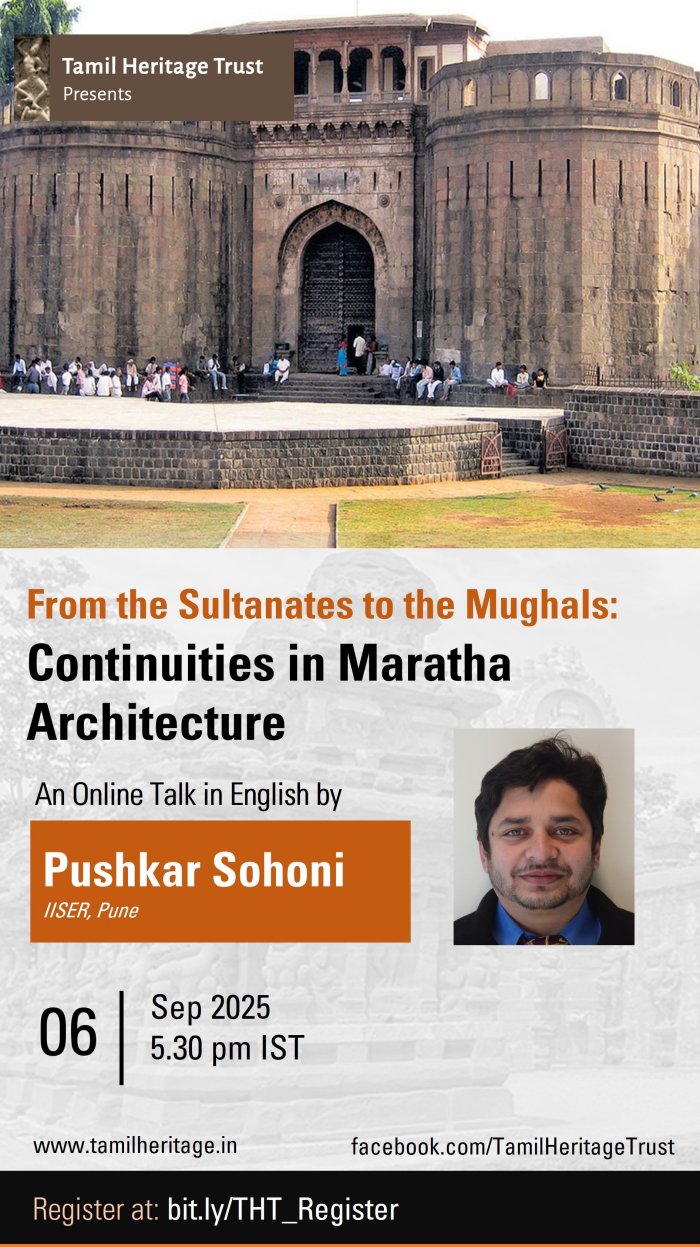
Online Talk in English on Saturday, September 6, 2025, 5.30 pm -
"From the Sultanates to the Mughals: Continuities in Maratha
Architecture"
Architect Pushkar Sohoni examines how the Marathas maintained the
architectural traditions of the Deccan Sultanates during their rule. He
explores the complex interplay of cultural and political identities
within the region to demonstrate how political histories do not neatly
map into architectural histories.
The independent Maratha kingdom of Chhatrapati Shivaji was founded in
the mid-seventeenth century, when the sultanates of the Deccan were
defending against the expansionist Mughal empire. The Mughals slowly
anchored themselves in the Deccan, and the kingdom of the Nizam Shahs of
Ahmadnagar was finally subdued in 1636. Over the next half century, as
the Adil Shahs of Bijapur and the Qutb Shahs of Golconda found
themselves in a weakened position against the Mughals, the Marathas
consolidated their gains with building campaigns. It is not surprising
that the architectural expression of the early Maratha kingdom had the
same artisanal qualities and visual vocabulary as the sultanates of the
Deccan, given that most of the Maratha elite families had served at
sultanate courts.
Talk on YouTube
Pushkar Sohoni is a historian of architecture and material
culture at IISER Pune, whose scholarship illuminates the rich interplay
of art, society, and identity across South Asia - particularly the
Deccan. With a PhD from the University of Pennsylvania and a background
in architecture, Sohoni deciphers how buildings, coins, scripts, and
landscapes function as powerful, often under-explored historical texts.
Tamil Heritage Trust
tamilheritage.in
tamilheritage.in@gmail.com
youtube.com/@TamilHeritageTrust
919444823681
|
|
|