Snippets of Information - Crafts
* 21 August 2026
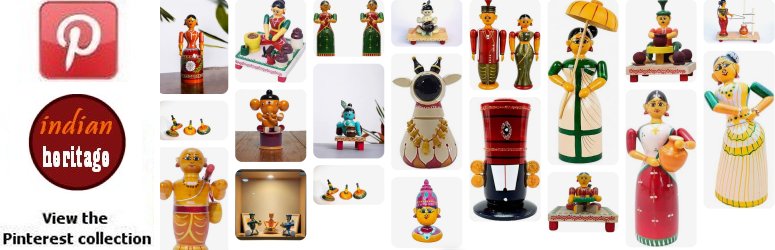
Etikoppaka dolls, or Etikoppaka Bommalu, are traditional wooden
lacquerware toys crafted in the village of Etikoppaka along the Varaha
River in Andhra Pradesh, depicting rural life, animals, mythological
figures, wedding processions, and cultural deities.. Rooted in a
400-year-old tradition, these eco-friendly toys are made from soft
ankudu wood (Wrightia tinctoria) and colored using safe, natural
plant-based dyes and lacquer. Colored using non-toxic natural dyes
extracted from seeds, bark, roots, leaves, and lac, they feature smooth,
rounded contours with no sharp edges, making them safe for children.
Awarded a Geographical Indication (GI) tag in 2017 for their unique
cultural heritage. d
* 19 Nov 2025
The Nizams' Jewellery is one of largest and rich collection of
Jewels that was purchased in 1995 by the Government of India at a cost
of Rs. 218 Crore. The collection had remained in the custody of "H.E.H.
Nizam Jewellery Trust" and "H.E.H. Nizam Supplemental Jewellery Trust"
formed by the last Nizam Mir Osman Ali Khan in 1951-1952 to safe-guard
the ancestral wealth of the family. The trustees kept this treasure of
great historical value in the vaults of Hong Kong Bank. When the
Government of India acquired this collection in 1995, after a prolonged
legal battle, it was shifted to the vaults of Reserve Bank of India
(RBI), Mumbai, where it remained till 29th June 2001. It was brought and
kept in the vaults of the RBI, New Delhi, for safety.
It covers a period ranging from 18th century to the early 20th century.
The collection in-dudes, sarpeches, necklaces, belts and buckles,
bracelets and bangles, earrings, armlets, toe rings, finger rings,
pocket watch and watch chains, buttons and cufflinks, etc. While the
diamonds from the celebrated mines of Golconda and Colombian emeralds
predominate, there are Burmese rubies and spinets and pearls from Basra
and the Gulf of Mannar, off the east coast of India. Imperial diamond
now known as Jacob diamond (almost double the size of Kohinoor Diamond),
a collection of 22 unset emerald pieces, seven stringed pearl necklace
(satlarah), etc. were on display.
Nizam’s jewellery was displayed at National Museum. The first exhibition
was held in 2001 from 29th August - 15th September, 2001 in which 173
objects were put on display. The second exhibition was held from 26
Sept-30th December 2007. The third exhibition was held from 19th
February, 2019 to 5th May 2019.
Source: Jewels of India: The Nizam's Jewellery Collection, nationalmuseumindia.gov.in
* 4 Oct 2025
Kanihama village in Central Kashmir’s Budgam district with a rich history of Kani Shawl weaving, has been declared a Craft Tourism village
by the Government of India. This recognition has brought numerous
benefits to the local artisans, who are now receiving direct orders from
tourists visiting the village. The Common Facilitation Centre (CFC) in
the village offers live demonstrations of Kani shawl making, showcasing
the artisans’ skills and the rich history of the craft. Tourists can
witness the entire process, from designing to weaving, and even place
orders directly with the artisans. With over 500 artisans in the village
and surrounding areas, this initiative has provided a significant
source of income for the locals.
Source: risingkashmir.com
Kashmiri Artisans hail Kanihama’s new status as Handloom Craft tourism village in Budgam District
* 23 Jul 2025
The basic material of Bidriware is an alloy of zinc and copper in
the proportion of 16:1. It is on this alloy that artistic designs in
pure silver are engraved. The Bidriware undergoes an eight-stage
process. The 8 stages are molding, smoothening by file, designing by
chisels, engraving by chisel and hammer, pure silver inlaying,
smoothening again, buffing and finally oxidizing by soil and ammonium
chloride. Now the Bidri item is ready for the final step of making the
surface permanently black so that the silver inlay design will stand out
in bright contrast against the dark background. There is a particular
type of soil found in the inner depths of ruins which are three hundred
years old, in buildings where neither sunlight nor rain has fallen for
hundreds of years. This soil, when mixed with ammonium chloride and
water, produces a very special paste which is rubbed onto the heated
Bidri article. The paste darkens the body of the piece, but has no
effect on the silver inlay. As the paste is rinsed off, the design
springs dramatically into view, the shining silver resplendent against
the black surface. Finally, oil is rubbed on the piece to deepen the
black matt coating.
Source: cauverycrafts.com
* 12 Aug 21
Kondapalli Toys (Kondapalli Bommalu) are brightly coloured
hand-carved wooden toys in bright reds, greens and yellows,
traditionally using natural powder colours.
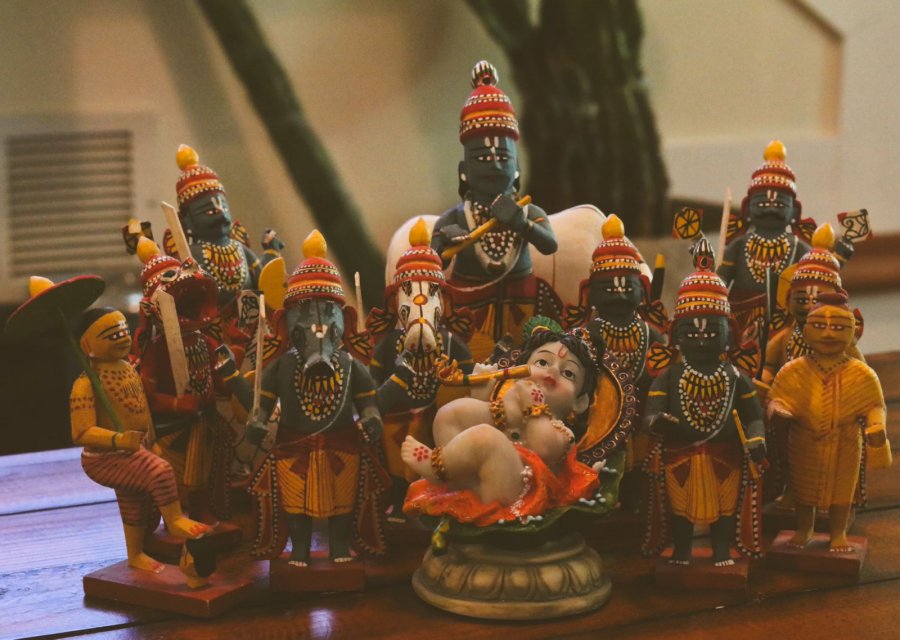
Photo courtesy: Lakshmi Vuppuluri
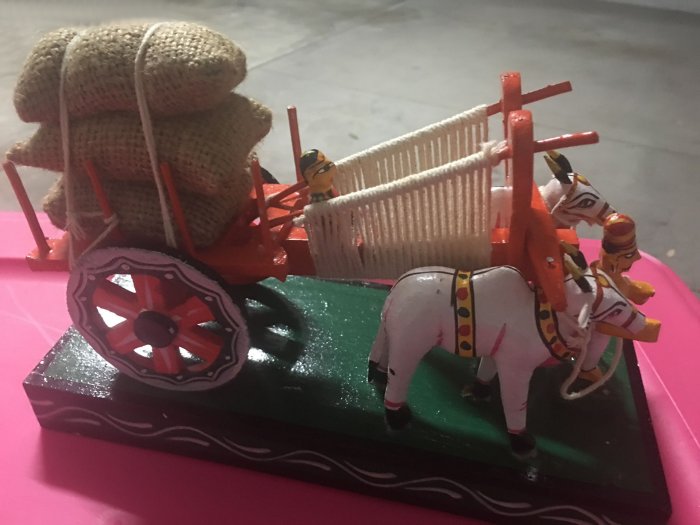
Photo courtesy: Lalitha Srinivasan
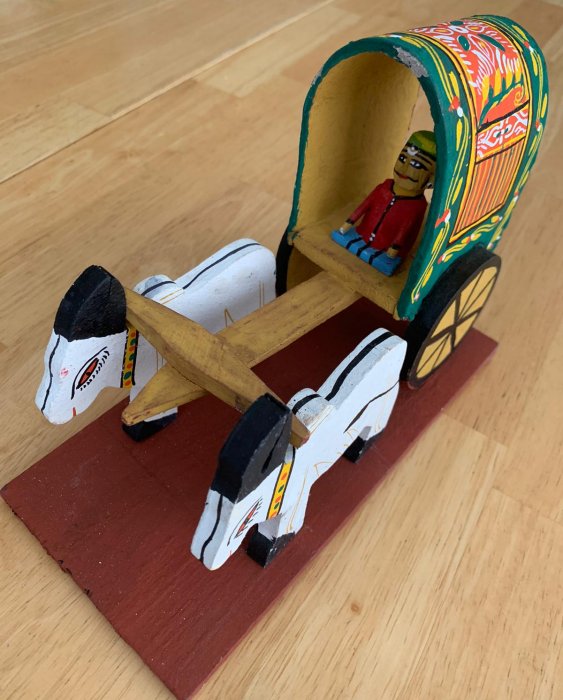
Photo courtesy: Lakshmi Vuppuluri
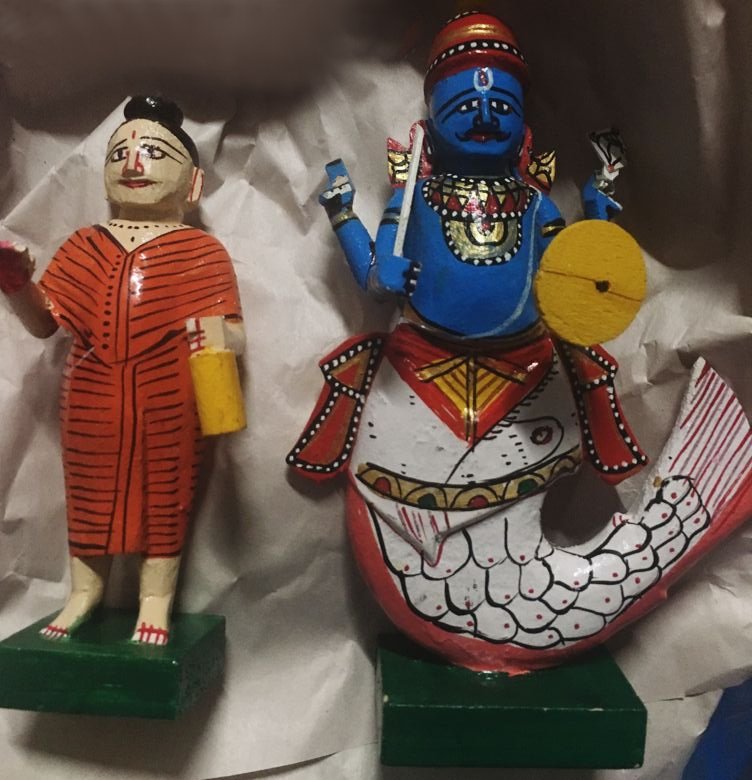
Photo courtesy: Lalitha Srinivasan
The craftsmen migrated from
Rajasthan to Kondapalli near Vijaywada around the 16th century. The
knives used as tools for carving and the colours and brushes were
originally made by the artisans themselves. They carve the toys
out of soft wood known as Tella Poniki (punki). A paste made out of
tamarind seed powder & sawdust known as makku is used to fill up
gaps and to add features to the toys.
At present, the artisans have started using commercial glue and enamel
paints in place of the resin gum and natural powder colours.
References: Toys'story by Sabita Radhakrishna, thehindu.com, 3 Sep 2015 ; wikipedia.org
|