Snippets of Information - Dance
Bharatanatyam
* 15 Sep 2025
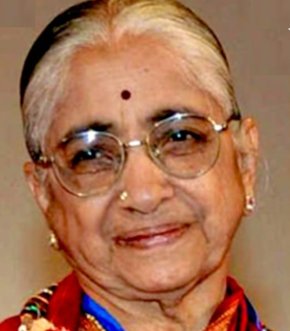
Image Source: Internet
A. Sarada (later Sarada Hoffman) (1929 - 2025) was born in 1929 in Madras. She passed away on 14 Sep 2025. She was 96.
One of Rukmini Devi’s earliest students, she also trained under
Pandanallur Chokkalingam Pillai, Dandayudhapani Pillai and Mylapore Gowri Ammal. She honed her
music skills under maestros Mysore Vasudevacharya and MD Ramanathan.
From Gurus Ambu Panicker and Chandu Panicker she received training in
Kathakali. She completed her studies in 1947 and was appointed a teacher
and lead dancer in Kalakshetra. She completed her studies in 1947
and was appointed a teacher and lead dancer in Kalakshetra. During the
last fifty years, Sarada Hoffman has rendered yeoman service to dance.
Initially, she performed extensively with the Kalakshetra troupe and
later concentrated on teaching and composing in Bharatanatyam style. She
has been the main strength behind Kalakshetra's training activity and
is credited with maintaining the distinct quality of its technique and
style. A number of eminent dancers and teachers including Yamini
Krishnamurti, Adyar Lakshman, C.V. Chandrasekhar, Dhananjayan and Shanta
Dhananjayan, Krishnaveni Lashmanan, Ambika Buch, Kala Ramesh,
Savitri Jagannatha Rao, Balagopalan, Janardanan, Neila Satyalingam among
others have had the benefit of training under her guidance. After her
retirement as head of the dance department in 1989, she continued to
serve Kalakshetra as an emeritus member of the faculty until 1996. She
has been honoured by various organizations for her work as a guru.
Sarada Hoffman received the Sangeet Natak Akademi Award in 1996.
In 2001, she received the first Rukmini Devi Medal for Excellence in the
Arts, established by the Centre for Contemporary Culture, New Delhi.
Source: sangeetnatak.gov.in
When I (Sarada Hoffman) was ten, she (Rukmini Devi) said I was ready to
learn dance. By then, she had started Kalakshetra, where Meenakshi
Sundaram Pillai conducted the classes for her, while his nephew,
Chockalingam Pillai, conducted the classes for the other students. I was
a student for four years under him.
When Menakshisundaram Pillai and Chockalingam Pillai left, Rukmini Devi was left without professional teachers.
She conducted the classes herself. She learnt to handle the nattuvangam
(cymbals) from Bhairavam Pillai, who played the mridangam for her
concerts. She conducted my (Sarada Hoffman) arangetram and did the
nattuvangam for my performance. I was about 14 then. Then on, she began
training her own teachers.
Source: Sarada Hoffman - Bharatanatyam dancer, Interview, kutcheribuzz.com, 10 June 2000
* 15 Sep 2025
Born in the temple town of Madurai, Tamil Nadu on the 29th of February 1904, Rukmini Devi was one of eight siblings.
Her childhood was spent in the environment of the Theosophical Society,
growing under the influence of inspiring people like Dr. Annie Besant,
Dr. George Sydney Arundale, C W Leadbeater and other thinkers and
theosophists of the time. After the death of her father, the family grew
close to Dr. George Arundale, a distinguished Theosophist and an
associate of Dr.Annie Besant.
In 1920 she married Dr. Arundale with the blessings of Dr. Annie Besant
and with the approval and support of her mother and brothers. She began
to travel widely with her husband on Theosophical work. She also became
very close to Dr. Annie Besant and helped her with her work. Although
she was very young at that time, she observed and absorbed a great deal
of the values and the concerns of those who worked with Dr.Besant for
the freedom of India and for the revival of India’s cultural heritage.
(Dr. Arundale went on to become the President of the Theosophical
Society after Dr. Besant’s passing and Rukmini Devi herself was an
active member of the Theosophical movement).
It was on one of her travels that Rukmini Devi met the famed ballerina,
Anna Pavlova, at Covent Gardens, London. Pavlova introduced Rukmini Devi
to ballet and had her disciple, Cleo Nordi, give the young woman
lessons while on board the ship. Dr. Arundale believed that after this
experience, Rukmini Devi was “a changed person.”
She began attend Bharatantyam dance performances and sought out
practitioners of the art. She resolved to learn the art from these
specialists. Pandanallur Meenakshisundaram Pillai was her guru though it
has been mentioned that she was initiated into bharatanatyam by
Mylapore Gowriammal. Transcending orthodoxy (that believed that girls of
“upper caste families must not learn the art of temple harlots”)
Rukmini Devi, already in her early thirties, worked tirelessly and with
great enthusiasm to understand for herself the artistic spirituality of
Indian dance, to learn it in its purest form. She gave her first
performance at the Diamond Jubilee celebrations of the Theosophical
Society in 1935. But to her, it was not enough that she danced
herself, she wanted to find young people who would dedicate themselves
along her, to its revival.
Rukmini Devi was to devote the rest of her life to Kalakshetra, the
institution that she created, funding it through her own resources and
through the donations of friends and well-wishers. Dr.Arundale stood
firmly by her side, actively working with her as she built her
institution with vision and commitment, nurturing the academy through
many difficulties.
Her deep commitment to pure art and sensitivity to fine nuance drew
great musicians like Tiger Varadachariar and his brother,
Krishnamachariar, Mysore Vasudevachariar, Budalur Krishnamurthy Sastri,
Papanasam Sivan, Veena Sambasiva Iyer along with great dancers like Ambu
Panikar, Chandu Pannikar , Mylapore Gowriamal and many others to
Kalakshetra.
The first professional teacher in Kalakshetra was Muthukumara Pillai.
Later on Meenakshi Sundaram Pillai also trained students at Kalakshetra.
The earliest students were Rukmini Devi's niece Radha (Radha Burnier),
G.Sundari's sister Leelavati and A. Sarada (Sarada Hoffman).Chandu Panikkar was the Head of Kathakali Department for 16 years.
Sources: kalakshetra ; uniquemusicworld2021(fb) ; sahapedia.org
* 28 Feb 2022
K. P. Kittappa Pillai, a brilliant musician and choreographer
belonging to the traditional community of artists was a fifth-generation
descendant of the illustrious Thanjavur Quartet who are credited with
the codification of adavus and the development of the Bharatanatyam
format. He choreographed the dance for Sarabendra Bhoopala Kuravanji
with Balasaraswati and Alaya Geetavadya Nrityanjali or Navasandhi Stuti.
He set up the dance formats and the Varna Mettu’s for Kalidasa’s Ritu
Samhara in the original Sanskrit and some of the poetic works of Tanjore
ruler Shahaji in Marathi. His remarkable compositions like the
Navasandhi Kavituams remain a jewel in the Bharatanatyam
repertoire. A son of the illustrious vaggeyakara Sangita Kalanidhi
K. Ponniah Pillai and Lakshmi Ammal, he was named Sabhapati; Kittappa
was his pet name. He was also known as K.P. Krishnamurti Pillai. Trained
by Natesa Sastry, grandson of Syama Sastry, in vocal music, he became
skilful in playing the mridangam as well. He learnt the art of
nattuvangam from his maternal grandfather, the illustrious Pandanallur
Meenakshisundaram Pillai (a disciple of Mahadeva Nattuvanar belonging to
the direct lineage of Sivanandam of the Tanjavur Quartet).
Kittappa Pillai initially started out as a vocalist, performing with his
maternal cousin Narayanaswami. After the demise of his cousin, Kittappa
stopped rendering vocal concerts. For sometime he assisted
Meenakshisundaram Pillai who was teaching at Kalakshetra. He
concentrated on teaching the varied aspects of nritta and abhinaya in
Bharatanatyam, doing nattuvangam, and composing jatis. All this
gradually expanded over the years after senior stalwarts of his
paramapara passed away, and Kittappa Pillai became the byword for
nattuvangam and technical excellence in Bharatanatyam. During his career
of four and-a-half decades as an expert dance master conductor
choreographer, he came to be known as a unique teacher of countless
Tanjore compositions, many of which he re-created from memory and close
observation of his own gurus.
Kittappa Pillai’s nritta technique had an inherent musical quality.
Almost every creation was a masterpiece. His rhythmical patterns had a
special touch, often based on ‘usi eduppus’ (commencing off the beat).
Source: sahityakalp.com
- Guru Kittappa's choreography of adavu-s is always in the Madhya laya.
Sometimes he combined it with the chollu-s in drut. His chollu-s form a
beautiful dialogue with the adavu patterns. His teermanam-s,
particularly in varnam, are never too long except the first Trikala
Teermanam.
- He gave a lot of importance to the plain rendering of notes. He did
not advocate unnecessary Bhruga-s or the twisting of words in singing
his Sangati-s in Varnam-s and Padam-s gave utmost importance to words
and emotional content.
- His dance philosophy music came first. He saw the visuals along with
the music. So, whenever he choreographed a pattern into a musical
structure, it blended perfectly into it.- - He used to express his
philosophy of Bharatanatyam choreography in just a few words, “Dance
should be beautiful to see AND to listen.”
Source: GURU K.P. KITTAPPA - A TREASURE HOUSE OF BHARATANATYAM (Natya Kala Conference 2000) by Dr. Sucheta Chapekar, narthaki.com
* 28 Feb 2022
Thanjavur Quartet's house, a historic landmark - situated behind
the western walls of the Brihadeeswara Temple at 1818, West Main Street,
Thanjavur. This house was gifted to my ancestors by Tulaja II,”
says Chandrasekhar, son of Kittappa Pillai (eighth generation of the
Thanjavur nattuvanar family).
Source: The roots of legacy: A visit to Thanjavur Quartet's house, Jagyaseni Chatterjee, Aug 25, 2016, thehindu.com
* 28 Feb 2022
Guru Vadivelu learnt the violin from a Christian priest in the Thanjavur
court. Impressed by his playing of Carnatic kritis on this western
instrument, the Travancore king Swati Tirunal gifted him an ivory violin
in 1834.
Source: The roots of legacy: A visit to Thanjavur Quartet's house, Jagyaseni Chatterjee, Aug 25, 2016, thehindu.com
* 28 Feb 2022
Beginning from Gangaimuthu Nattuvanar, grandfather of the Thanjavur Quartet
and father of Subbarayan, the family has continued its artistic
endeavours, contributing immensely to the field of Bharatanatyam.
Ponnayya was a composer and vocalist, Chinnayya was a choreographer,
Sivanandam, a mridangam vidwan and nattuvanar, and Vadivelu was a
composer and violinist.
Source: The roots of legacy: A visit to Thanjavur Quartet's house, Jagyaseni Chatterjee, Aug 25, 2016, thehindu.com
* 16 Aug 2021
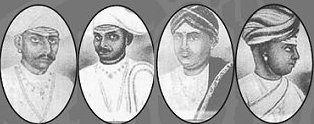
Thanjavur Quartet (Thanjai Naalvar in Tamil) refers to Chinnayya
(1802-1856), Ponniah (1804-1864), Sivanandam (1808-1863) and Vadivelu
(1810-1845) - four brothers who codified and systematized the 'SADIR'
format were nattuvanars at the court of Maratha King Serfoji II (1798-1832 A.D.) in the early 19th century.
Descendants of the Thanjavur Quartet
Gurus Meenakshi Sundaram Pillai ; Ponnayya Pillai ; Chokkalingam Pillai ;
Subbaraya Pillai ; Kandappa Pillai ; K.P.Kittappa Pillai ;
K.P.K.Chandrasekharan
* Jul 2021
The origin of the name Bharatanatyam came from 4 Sanskrit words. Divided
in 4 sections, Bha-ra-ta-natyam. Each syllable represents a different
word and meaning. Bha comes from Bhava, which means expression. Ra comes
from Raga, which means melody. Ta comes from Tala, which means rhythm.
Natyam mean dance. If you broke Bharatanatyam into four Sanskrit words
it would read Bhava, Raga, Tala and Natyam. These aspects: expression;
melody; and rhythm; are very important in Bharatanatyam.
Source: danceasia.org
* Jul 2021
Sadirattam or Dasiattam was later rechristened as Bharatanatyam by the
Madras Music Academy by a resolution passed accepting the suggestion of
E.Krishna Iyer. Taking the new nomenclature Rukmini Devi popularized
that name to attribute dignity and divinity to the performing art form
and maybe we can say she did give a new lease of life to this ancient
natya which I suppose has an antiquity of more than 3000 years.
Source: V.P.Dhananjayan, narthaki.com
|