MUSIC
Profiles of Artistes, Composers, Musicologists
Unless otherwise specified, the profiles in this section are
from
The Garland, Another Garland, Yet Another Garland and The
Fragrant Garland by Mr.N.Rajagopalan
BANGALORE
NAGARATHINAMMAL - THYAGA SEVA SAKTHA ...............(Nov.3, 1878 - May
19, 1952)
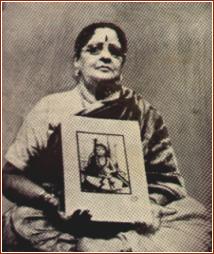
The great
lady of Bangalore belonged to the fragrant period which saw a galaxy of
illustrious women musicians like Veena Dhanammal, Salem Meenakshi, Enadhi
Lakshmi Narayani Sisters, Coimbatore Thayee, Bangalore Thayee, Tiruvarur
Rajayee and Kolar Nagarathinam. The trio MSS, DKP, MLV joined them later.
But Bangalore Nagarathinammal was altogether of a different type in that
she was able to look beyond herself and music rendition and focus her attention
on the source of such resplendent music. Her sublimated soul envisioned
the Cauvery and its music - soaked cultured waters not only at Tiruvaiyaru
but at the distant Mercara where lies its source. Others came, sang and
left. But her genius perceived something greater, enduring and substantial.
She enjoys the unique distinction of having surrendered her all to the
service of the Great Bard of Tiruvaiyaru, Tyagaraja.
With single-minded
devotion and dedication, she sold her properties, pooled her income and
enlisted the support of all to commence the construction of the Samadhi
of Tyagaraja on the bank of the Cauvery on October 27, 1921 and perform
the Kumbabishekam on January 7, 1925. She started the annual celebrations
(aradhana) on a firm and grand scale. The samadhi lands were donated by
Sri Mannapa Saheb and Sri Rajaram Mannaji Surve. And she spent her last
years there giving lessons on Tyagaraja songs at the 'Tyaga Brahma Nilayam',
a dedicated construction work in which the eminent cine actor, Chittoor
V.Nagayya played the principal role. Quite fittingly, her samadhi is located
near the samadhi of the bard. Another wish fulfilled. Nagarathinammal was
an amalgam of sterling character, obsessive and noble dedication to good
causes held dear to her heart and of dharmic conduct which combined in
itself the essence of the Ramayana service - oriented characters Sabhari,
Lakshmana, Vibishana and Hanuman and the achievements on a mini scale of
a Rajaraja Chola. Devoted to her gurus, she performed guru poojas anually
and also Hanumat Jayanthi. She was chosen specifically to sing a Sanskrit
invocation at the All India Sanatana Dharma Conference in 1929. She gave
a large number of concerts and the bulk of the proceeds went for the construction
of the Tyagaraja Samadhi and the Mysore Choultry at Tiruvaiyaru for the
benefit of Kannadigas.
Born at Mysore,
of Vakil Subba Rao and Puttulakshmi, she learnt Sanskrit and music under
Giripatta Thimmayyah and violin from her uncle Venkitasami Appa of Bangalore.
Had further training in violin under Munuswamy Appa, a disciple of Wallajahpet
Krishnaswami Bhagavathar. Her desire for knowledge was so intense that
she learnt Bharatanatyam under Bangalore Kittanna and Abhinaya from Madras
Tiruvenkatachariar. Her over-all vidwat was polished of by Bidaram Kittappa.
Puttulakshmi was discarded first by Subba Rao and later by Thimmayyah also.
But she bore her travails and tribulations and brought up her daughter
with an iron will. With multi-sided acomplishments, Nagarathinam made her
debut significantly at Veena Seshanna's house in her fifteenth year. Palaces
and Institutions availed of her immense training and talent both in India
and in Sri Lanka. It is said that she gave 1235 engagements between 1905
and 1934, which is equivalent to ten times that now.
She enjoyed
a 'gambhira' voice. Her infatuation with the songs and life of Tyagaraja
was so intense and sublime that she executed a will on January 3, 1949
setting apart her assets to construct the Samadhi and to run a gurukula
at Tiruvaiyaru to propagate the Bard's songs. There was Yaga, Yoga , Tyaga
and Bhoga with nadopasana in her life of suffering and achievement.
Her only daughter
died. Her attempt to adopt a girl failed. Her sufferings while young and
these failures tended only to harden her admiration for Tyagaraja, the
Prince of Renunciation, and her resolve to accomplish and achieve what
all others had ignored. Her intense love of his songs was matched only
by her passion for Devaranamas and to demonstrate that Purandara songs
could also be sung likewise in such an elaborate and scholarly manner,
she got up a concert of Bidaram Krishnappa at Madras to be covered only
by Devaranamas. Mysore Vasudevacharya says, 'Ragalapana, Swarakalpana,
neraval, everything was there as in a traditional concert. The audience
felt delighted. They realised for the first time that the Kannadigas also
have their own individualistic heritage'
She rarely
rendered the kritis of Dikshitar as she felt that she would not be able
to do justice to them because of her inadequate knowledge of Sanskrit.
Tyagaraja and Purandaradasa had son her heart so fully that it had no space
for others !
Publications
:
Her publications
include Madhyapanam in Telugu, Sri Tyagaraja Ashtothra Namavali
in Sanskrit and Panchee Karana Bowdheeka in Tamil.
Nagarathinammal
reprinted the Telugu classic 'Radhika Swayamvaram' of Muddu Palani,
a courtesan of the 18th century. Police seized all the copies taking objection
to its high eroticism. Only in 1947 the ban was lifted. There was a fresh
edition in 1952.
Titles &
Honours :
March 6, 1949
- Tyaga Saktha by President of India
Vidya Sundari
by Puranam Suryanarayana Tirthar
1932 - Gana
Kala Visaradha by Kaviraja Krishnamurti Sastri.
Nagarathinammal
needs no better honour than the appreciation and gratitude of the thousands
who gather annually at Tiruvaiyaru for the Aradhana. 'Earn, Conserve, Distribute',
this is my life-mission, declared the Founder of the Annamalai University.
The application of the principle to the life of Nagarathinammal reveals
that she belongs to the galaxy of eminent women of India. Literally she
got dissolved in every respect in nadopasana !
KANCHIPURAM
NAINA PILLAI
(C.Subramania
Pillai) : Pallavi Colossus.............(July 25, 1889-May2,1934)
Glittering
rendition, emphasis on laya, a full bench of accompanists, featured the
concerts of Kanchipuram C.Subramania Pillai, later called Naina Pillai.
Tall, well-built, slightly dark in complexion with a broad face and well
dressed, Naina Pillai was known for his praise-worthy dedication to the
art and science of music, excellent character and for robust self-respect.
He was an addict to high values and adhered to the Code of Conduct laid
down by Thyagaraja in his 'Niti Chala Sukhama'. His regard for the
sanctity of music was so intensely pure that he resisted the recording
of his music lest it should be played at odd places on road sides pulling
down the image of the composer, the song and the musician. He declined
titles and had the highest respect for his gurus; resisted the lure of
gold and money when not due. He never compromised on principles even in
times of distress.
His dignified
humility, apt to be mistaken for egoism, was clear from his apologising
to Tiger Varadachariar for not singing 'Vinata' as desired by him and prostrating
before Mazhavarayanendal Subbarama Bhagavathar seeking his blessings. A
stickler for fair norms, once he reached the concert village late due to
a car accident. He apologised profusely, started his concert at 10 pm,
and in spite of personal injuries and fatigue went on upto 2 am. He fainted
due to over-exertion in his anxiety to satisfy the music-loving people
kept waiting. Thus his sense of self-respect could acknowledge and respect
that virtue in others too. He was a gentleman and was aggressive in being
so.
His quest for
more and more songs was remarkably insatiable and his repertoire went on
increasing. His concerts were distinctly unique in having the largest number
of accompanists rarely seen in others except his own disciple Chitoor Subramania
Pillai. There was a veritable array of accompanists - kanjira, morsing,
konnakol, ghatam, dolak, etc. His addiction to 'Laya' was exceptional and
the stage would vibrate with the competing performance of the different
accompanists which he would enjoy. The great vocalist maestro handled kritis
with such crispness and vigour that none felt the tinge of satiation. His
note-worthy favourites included- Janaki Ramana - Suddha Seemanthini, Mamavasathatham
- Jaganmohini, Ranidhi radhu - Manirang and Paramathmudu velugu - Vagadiswari.
His swaras and pallavis were masterly, racy and scintillating. Pallavi
and laya were his forte.
Born at Kanchipuram,
of Kanchipuram Kamakshi Ammal and christened Subramaniam, he had a boisterous
youth. His aunt-musician, Dhanakoti Ammal wanted to get him trained by
Puducheri Rangaswami Ayyar, a disciple of Ettayapuram Ramachandra Bhagavathar
while young but he was not interested. His mother and aunt were disciples
of Kasi Sastri, a great grandson of Syama Sastri of the Trinity. So, they
were anxious to carve out a career as a musician for Subramaniam, called
at home as 'Naina' which stayed to the end. Naina was ultimately tamed
by a musically-minded sanyasi called Kumaraguru or Paripurnananda, who
trained him initially. Naina drew inspiration from the Ettayapuram maestro,
Ramachandra Bhagavathar. The real turning point was provided by the concert
of Konerirajapuram Vaidyanatha Ayyar with the stalwarts Tirukodikaval Krishna
Ayyar(violin), Chennai Anganna Naidu (mridangam) and Pudukottai Manpoondia
Pillai (kanjira). The concert was so inspiring that the irrepressible Naina
became the most ardent devotee of music to blossom into one of the stalwarts
of Carnatic music of ever-lasting fame.
His close contacts
with Mannargudi Konnakol Pakkiria Pillai and love and passion for an ensemble
of percussive accompanists carried him on the vibrant path of 'laya' (rhythm,
tempo) to such an extent, that it became an article of faith, an obsession
and a mission to him. His pronunciation was clear and lucid. He increased
his repertoire by learning about four hundered Tyagaraja kritis from Jalatarangam
Ramaniah Chettiar. He learnt the nuances of songs and ragas from Veena
Dhanammal in a quid pro quo for teaching her 'Tanayunibrova'. He
learnt Thevaram from Appadurai Achariar of Vellore. He took a vow
to sing atleast two new songs of Thyagaraja in every recital. His swara
elaboration and pallavi technique blazed a wholly new trail in the history
of Carnatic music. He set to tune Tirupugazh songs and popularised them.
He was thus different from other leaders of his time. He organised and
celebrated Tyagaraja Festival with much dedication. A strict teacher, he
was kind to his large retinue of disciples which included - Chittoor Subramania
Pillai, Brinda, Tiruparkadal Srinivasa Ayyangar, Tiruvizhimalai Kalyanasundaram
Pillai, N.S.Krishnaswamy Ayyangar and Seithur Sundaresa Bhattar. The great
vocalist died at the height of fame and glory but prematurely, a victim
of diabetes and tuberculosis. His memory is treasured by music enthusiasts.
A.V.NARAYANAPPA
- NAGASWARA / MUKHAVINA ARTISTE.............(June 21 1912 - 1994)
Narayanappa
was born in Arakalgud of Venkatappa. He had his training in nagaswaram
under his father Venkatapa, S.C. Beluriah, Dodda Sinappa, Mysore Rangiah
Naidu and Perambalur P.N.Angappa Pillai. He had his training in vocal music
under B.Devendrappa of Mysore Palace and Alathur Venkatesa Ayyar. Narayappa
had thus copious training under distinguished vidwans of proven merit.
he was an expert in playing the ancient mukhavina also. He had given extensive
concerts at various places and functions. A popular vidwan.
Titles &
Honours
Sangita Kalaratna
by Bangalore Gayana Samaja
Karnatka Kala
Tilaka by Karnataka Sangita Nrtya Academy
Karnataka
Rajyotsava Award
B.V.K.Sastry
writes that the most important service rendered to music by Narayappa was
the renovation of Kothandarama temple at Srirangapatnam on the banks of
the Cauvery and raising a brindavanam of Sri Tyagaraja with daily worship
and annual aradhana as at Tiruvaiyaru and that his aradhana has become
one of the important cultural events in Karnatka.
Page 2
|
|
|